
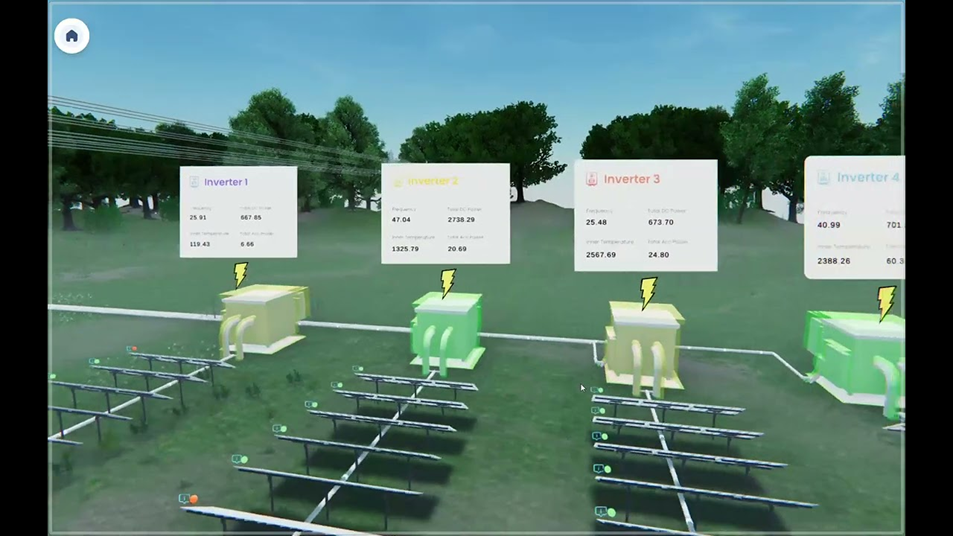
- Utility-scale solar assets are no longer judged only on installed capacity—they are judged on lifetime performance, availability, and ROI. Traditional SCADA and monitoring systems provide visibility, but not intelligence.
Digital Twin technology is changing that. By creating a live, data-synchronized virtual replica of a solar plant, asset owners can move from reactive maintenance to predictive, optimized operations.
I. Introduction
Solar PV asset management has historically been:
- Reactive (fix when something breaks)
- Fragmented (SCADA, inspection, reports in silos)
- Limited to historical performance tracking
Digital Twins change the paradigm:
- Real-time synchronization with physical assets
- Predictive insights using AI and physics-based models
- Closed-loop optimization between simulation and operation
This is not just monitoring—it’s continuous performance engineering.
II. Industry Context
The solar industry is scaling rapidly:
- Gigawatt-scale portfolios across geographies
- Increasing pressure on IRR and asset performance
- O&M costs becoming a major profitability lever
At the same time:
- Data availability is exploding (SCADA, drones, IoT sensors)
- AI and cloud computing are maturing
Digital Twins sit at the intersection of these trends, enabling digitized, intelligent asset management frameworks.
III. What Is a Digital Twin in Solar PV?
A Digital Twin is:
A dynamic, virtual model of a physical solar asset that continuously updates using real-time data and simulates system behavior.
Core characteristics:
- Bidirectional data flow (physical ↔ digital)
- Real-time updates
- Embedded analytics and predictive models
Unlike static simulations, Digital Twins evolve with the plant—reflecting degradation, faults, and environmental changes.
- Core Components
- Data Integration Layer
Digital Twins ingest multi-source data:
- SCADA (inverters, strings, weather stations)
- IoT sensors
- Drone and thermography inspections
- Maintenance logs
The challenge is not data collection—it’s data harmonization and contextualization.
Physics + AI Hybrid Models
Digital Twins combine:
- Physics-based PV models (irradiance, temperature, electrical behavior)
- AI/ML models for pattern recognition and forecasting
This hybrid approach enables:
- Accurate energy prediction
- Fault detection
- Scenario simulation
Recent research shows digital twin models can significantly improve PV power prediction accuracy through real-time adaptive learning.
Real-Time Synchronization
The defining feature:
- Continuous alignment between physical asset and digital model
This allows:
- Instant detection of deviations
- Identification of underperformance at string/module level
- Dynamic recalibration of models
Predictive Maintenance Engine
Digital Twins shift maintenance from:
- Scheduled → Condition-based
- Reactive → Predictive
Capabilities include:
- Fault detection and classification
- Degradation tracking
- Failure prediction
This directly reduces:
- Downtime
- O&M costs
- Energy losses
Simulation & Scenario Analysis
Operators can simulate:
- Component failures
- Cleaning schedules (soiling impact)
- Curtailment strategies
- BESS dispatch (if integrated)
This enables decision-making before action, not after impact.
- Why Digital Twins Are a Game Changer
- Performance Optimization
Continuous benchmarking against “ideal” plant behavior reveals hidden losses.
Cost Reduction – Lower O&M costs through predictive interventions and optimized scheduling.
Increased Energy Yield – Better tracking of losses (soiling, mismatch, degradation) improves output.
Portfolio-Level Intelligence – Standardized analytics across multiple plants enables:
- Cross-site benchmarking
- Centralized asset management
Practical Workflow
A Digital Twin-driven asset management workflow:
- Data Acquisition
SCADA + IoT + inspection data - Model Initialization
Build baseline digital replica - Real-Time Synchronization
Continuous data ingestion - Performance Benchmarking
Compare actual vs expected output - Anomaly Detection
Identify underperformance - Predictive Analytics
Forecast failures and degradation - Actionable Insights
Maintenance, cleaning, or operational adjustments - Feedback Loop
Update model with new data
This creates a self-improving system over time.
VII. Benefits and Limitations
Benefits
- Reduced downtime and O&M costs
- Improved energy yield and asset performance
- Real-time visibility and control
- Better decision-making through simulations
- Scalable across large portfolios
Limitations
- High initial setup complexity
- Requires clean, high-quality data
- Integration challenges across legacy systems
- Skilled expertise needed for model calibration
Bottom line: Digital Twins are powerful—but data quality and engineering discipline determine success.
VIII. Use Cases
Digital Twins are already being applied in:
- Utility-scale solar farms
- Hybrid PV + BESS systems
- Portfolio-level asset management
- Drone-based inspection integration
- Performance guarantee validation
They are particularly valuable for:
- Independent Power Producers (IPPs)
- Asset managers
- O&M service providers
Strategic Implications
For Developers
- Design for digitalization from Day 1
- Ensure sensor and data infrastructure readiness
For Asset Owners
- Shift from monitoring to active performance management
For Investors
- Better visibility into asset health and risk
- Improved confidence in long-term returns
Conclusion
Digital Twins represent the next evolution of solar asset management.
The shift is clear:
- From static reports → dynamic intelligence
- From reactive maintenance → predictive optimization
- From isolated plants → interconnected digital ecosystems
In a market where margins are tightening and portfolios are scaling, Digital Twin capability is becoming a competitive differentiator—not a luxury.
References
1. Olayiwola, O. et al. (2025) – “Enhanced Solar Photovoltaic System Management and Integration: The Digital Twin Concept” (Solar Journal)
2. Zhao, X. et al. (2024) – “A Novel Digital Twin Approach for Photovoltaic Power Prediction” (Scientific Reports)
3. MDPI (2023) – “Review on Digital Twins in Photovoltaic Installations”