
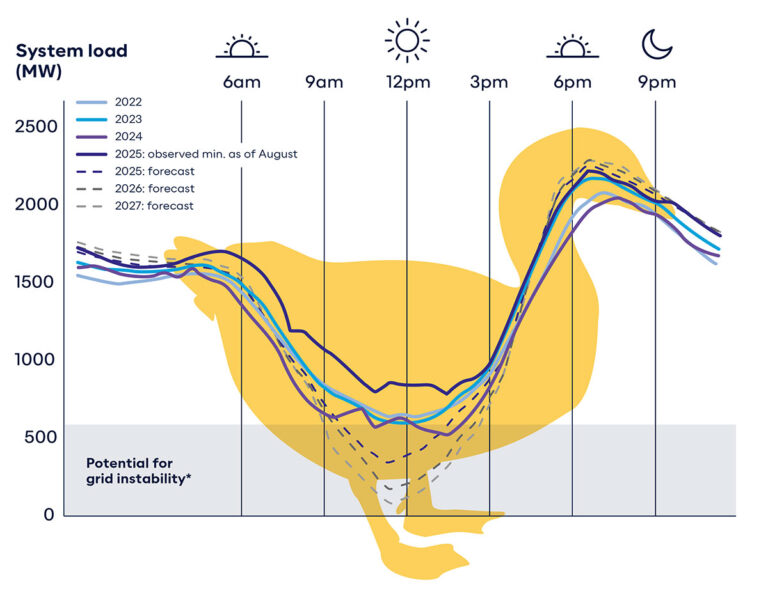
Image Source: Synergy
Solar project design is no longer just about maximizing annual energy yield. With the rapid global adoption of Time-of-Use (ToU) tariffs, the objective has fundamentally shifted: maximize revenue, not generation. This change is forcing developers, engineers, and investors to rethink how utility-scale Solar PV and Battery Energy Storage Systems (BESS) are designed, optimized, and financed.
I. Introduction
Historically, solar projects were engineered to:
- Maximize total kWh production
- Achieve the lowest Levelized Cost of Energy (LCOE)
That model worked under flat tariffs or feed-in tariffs (FiTs).
Today, under ToU regimes:
- Electricity prices vary by hour
- Peak demand periods command premium pricing
- Midday solar oversupply often leads to price suppression
Result: A plant producing more energy at the wrong time is less valuable than one producing less energy at the right time.
II. Industry Context
ToU tariffs are now standard or emerging across key markets:
- Australia (high solar penetration, duck curve effects)
- California (steep evening peak pricing)
- Europe (dynamic pricing and grid balancing markets)
- India (state DISCOMs introducing peak/off-peak structures)
This shift is driven by grid realities:
- Solar-heavy grids face midday oversupply
- Evening demand peaks remain unmet
- Grid operators incentivize dispatchable and flexible generation
The implication is direct: solar must evolve from passive generation to active energy management.
III. What Are Time-of-Use Tariffs?
Time-of-Use tariffs define electricity pricing based on time blocks:
- Peak hours → highest tariffs
- Shoulder hours → moderate tariffs
- Off-peak hours → lowest tariffs
For solar developers, this introduces a new optimization variable:
Not just how much energy is produced, but when it is delivered to the grid.
- Core Design Shifts
- From Energy Maximization to Revenue Optimization
Traditional KPI:
- Annual Yield (MWh/year)
New KPI:
- Revenue ($/year or IRR)
Design implication:
- Accept lower total generation if it improves revenue capture during peak pricing windows
VI. Rise of Solar + BESS as Default Architecture
Standalone PV is increasingly suboptimal under ToU.
BESS enables:
- Energy shifting (store midday, discharge during peak)
- Price arbitrage
- Grid support services
Design now includes:
- Battery sizing (MWh vs MW)
- Charge/discharge strategies
- Round-trip efficiency considerations
This is no longer optional in high-penetration markets—it’s becoming baseline.
V. DC/AC Ratio Optimization Is Changing
Earlier approach:
- Maximize DC/AC ratio to boost energy yield
Now:
- Oversizing DC may increase clipped energy, which can be stored in BESS
- Optimal DC/AC ratio depends on:
- Tariff structure
- Battery capacity
- Curtailment economics
Engineering must now align with market pricing signals, not just physics.
VI. Tracker Strategy Evolution
Trackers were traditionally optimized for:
- Maximum daily irradiance capture
Under ToU:
- Orientation can be tuned to shift generation toward high-value hours
Example:
- West-facing bias to enhance late afternoon output
- Reduced midday peak to avoid low-price generation
This is a deliberate trade-off: sacrifice peak irradiance for price-aligned output.
Curtailment Is Now a Strategy, Not a Loss
Previously:
- Curtailment = inefficiency
Now:
- Curtailment during low-price periods may be economically rational
Designers evaluate:
- Whether storing energy is better than exporting
- Whether not generating is better than selling at negative prices
This is a market-driven design philosophy.
Role of Software in ToU-Driven Design
Modern tools are adapting to this paradigm shift:
- RatedPower pvDesign software
Enables rapid layout and DC/AC/BESS configuration optimization across multiple scenarios - DNV SolarFarmer
Validates energy yield and integrates uncertainty into revenue forecasting - Market simulation platforms
Incorporate pricing curves and dispatch strategies
The integration of engineering + financial modeling is now critical.
Practical Workflow Under ToU
A modern ToU-driven project workflow looks like:
- Tariff Analysis
Understand hourly price curves - Baseline PV Design
Initial layout and generation profile - BESS Integration
Size battery for optimal arbitrage - Dispatch Modeling
Simulate charge/discharge strategies - Scenario Optimization
Compare multiple configurations:- DC/AC ratios
- Tracker orientations
- Battery sizes
- Revenue Modeling
Replace LCOE with IRR/NPV as primary metrics - Bankability Validation
Use tools like SolarFarmer for risk-adjusted outputs
VII. Benefits and Limitations
Benefits
- Higher revenue potential vs flat tariff systems
- Better grid alignment and stability
- Enables hybrid project innovation (PV + BESS)
- Improves long-term asset value
Limitations
- Increased design complexity
- Requires advanced modeling capabilities
- Revenue uncertainty tied to market volatility
- Higher upfront CAPEX due to storage integration
VIII. Strategic Implications
For Developers
- Faster iteration cycles are essential
- Site selection must consider tariff structures, not just irradiance
For Engineers
- Must think like financial modelers
- Design decisions directly impact IRR
For Investors
- Focus shifts from yield certainty to revenue predictability
- Requires deeper due diligence on dispatch strategies
Real-World Applications
ToU-driven design is already shaping:
- Utility-scale PV + BESS plants in Australia
- Merchant solar projects in the US
- Hybrid tenders in India
- Grid services markets in Europe
In these markets, projects without storage or ToU optimization are losing competitiveness.
Conclusion
Time-of-Use tariffs are not a minor policy tweak—they represent a structural shift in how solar projects are engineered.
The new reality:
- Energy is commoditized
- Timing is monetized
Winning projects will:
- Integrate PV + BESS from day one
- Optimize for price curves, not just sunlight
- Use advanced tools to iterate rapidly
References
1. Xue, W. et al. (2023) – “Research on the Optimal Design of Seasonal Time-of-Use Tariff Based on the Price Elasticity of Electricity Demand.” Published in Energies.
2. Zhong, Z. et al. (2018) – “Economic Dispatch Model Based on Time-of-Use Electricity Price for Photovoltaic Systems.” Published in Arabian Journal for Science and Engineering.
3. Arsalis, A. & Georghiou, G. (2025) – “Design and Assessment of Cost-Neutral Time-of-Use Tariffs in PV-BESS Microgrids.”