
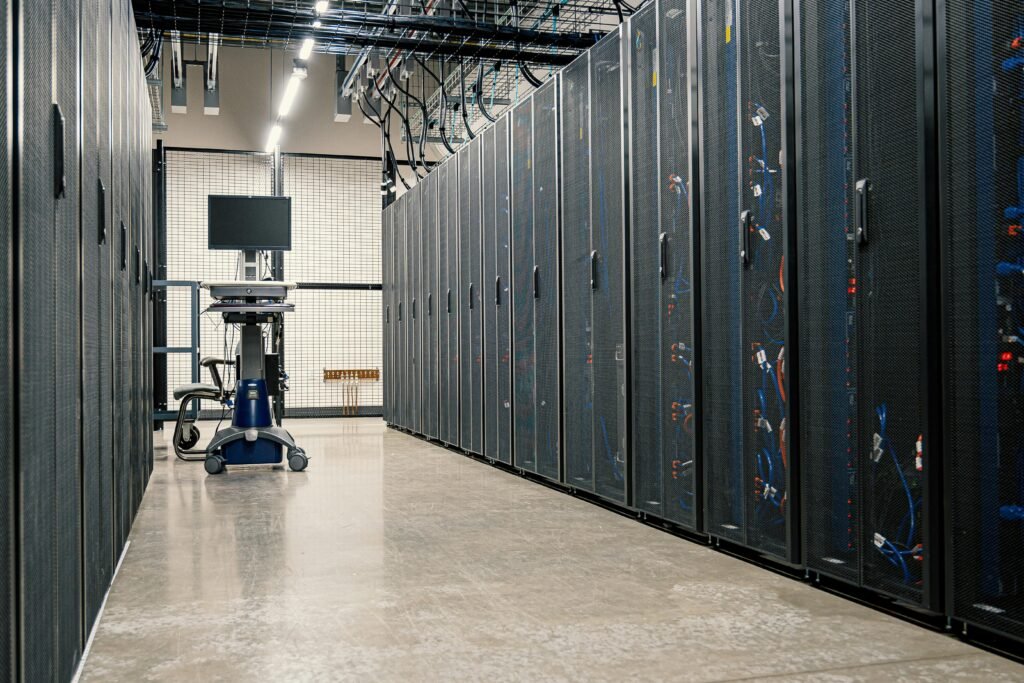
The surge in AI workloads and hyperscale data centers is not just a computing story – it’s an energy infrastructure story. Power demand is rising faster than grid capacity can respond, and reliability requirements are tightening. The result: utility-scale Battery Energy Storage Systems (BESS) are moving from optional grid assets to mission-critical infrastructure.
I. Introduction
AI has changed the load profile of electricity consumption.
Traditional demand:
- Predictable, cyclical
- Moderately tolerant to short interruptions
AI-driven demand:
- Continuous, high-density compute loads
- Extremely sensitive to power quality and uptime
- Rapidly scaling beyond legacy grid assumptions
For data center operators, downtime is not an inconvenience—it’s a direct financial and reputational hit. BESS is emerging as the bridge between volatile grids and deterministic compute demand.
II. Industry Context
The growth trajectory is aggressive:
- Hyperscale data centers expanding across the US, Europe, and Asia
- AI training clusters consuming 100–500 MW per campus
- Rack-level power densities increasing due to GPUs and accelerators
Companies like NVIDIA, Microsoft, Google, and Amazon are driving this shift.
The grid challenge:
- Interconnection delays (often 3–7 years)
- Transmission constraints
- Renewable intermittency
This mismatch between demand growth and grid readiness is accelerating BESS adoption.
III. Why Data Centers Need BESS
- Reliability Beyond Backup
Traditional data centers relied on:
- Diesel generators
- UPS systems for short-duration backup
Now:
- BESS provides instantaneous response
- Enables seamless transition during outages
- Reduces dependence on diesel
This is critical for AI workloads where even milliseconds matter.
Power Quality & Stability
AI infrastructure requires:
- Voltage stability
- Frequency control
- Harmonic mitigation
BESS acts as a grid buffer, smoothing fluctuations and protecting sensitive equipment.
Energy Arbitrage & Cost Optimization
Electricity pricing volatility is increasing under dynamic tariffs.
BESS enables:
- Charging during low-cost periods
- Discharging during peak pricing
- Demand charge reduction
For large campuses, this translates into multi-million-dollar annual savings.
Renewable Integration
Most hyperscalers have aggressive decarbonization goals.
BESS allows:
- Firming of solar and wind generation
- 24/7 clean energy matching
- Reduced curtailment
Without storage, renewable procurement alone cannot meet reliability standards.
- Design Implications for Utility-Scale BESS
- Shift from Grid-Centric to Load-Centric Design
Earlier:
- BESS designed for grid services (frequency regulation, peak shaving)
Now:
- BESS designed around data center load profiles
Key considerations:
- Peak demand matching
- Redundancy requirements
- Response time constraints
- Duration Requirements Are Increasing
Typical grid BESS:
- 1–2 hour duration
Data center-driven BESS:
- 4–8+ hours (or hybrid configurations)
Reason:
- Need to cover extended outages or renewable gaps
Hybridization with Solar PV
Co-located systems are becoming standard:
- Solar provides low-cost generation
- BESS ensures dispatchability
Tools like RatedPower pvDesign software are used for:
- Layout optimization
- PV + BESS co-design
- Scenario analysis
While tools like DNV SolarFarmer validate:
- Energy yield
- Risk and uncertainty
Behind-the-Meter vs Front-of-the-Meter
Two dominant architectures:
Behind-the-Meter (BTM):
- Directly supports data center load
- Maximizes reliability and cost savings
Front-of-the-Meter (FTM):
- Provides grid services
- Can be contracted to supply data centers
Increasingly, hybrid models are emerging.
Role of AI Itself in Energy Optimization
Ironically, AI is also solving the problem it creates.
AI-driven energy management systems:
- Optimize BESS dispatch
- Forecast load and generation
- Improve efficiency in real time
Companies like Tesla and Fluence are integrating advanced analytics into storage platforms.
Practical Workflow
A typical data center + BESS project involves:
- Load Profiling
Understand compute demand curves - Grid Assessment
Evaluate interconnection constraints - BESS Sizing
Define MW/MWh based on reliability targets - Renewable Integration
Add PV/wind where feasible - Dispatch Strategy Design
Align with tariffs and uptime requirements - Simulation & Optimization
Iterate scenarios for cost vs reliability - Bankability & Risk Analysis
Validate with industry-accepted tools
VII. Benefits and Limitations
Benefits
- Enhanced reliability and uptime
- Reduced dependence on diesel backup
- Lower operational energy costs
- Enables renewable energy integration
- Supports grid stability
Limitations
- High upfront capital cost
- Complex system integration
- Regulatory and interconnection challenges
- Battery degradation over lifecycle
VIII. Strategic Implications
For Developers
- Data centers are becoming anchor customers for BESS projects
- Long-term PPAs and energy contracts are evolving
For Engineers
- Must design systems around load behavior, not just generation
- Integration complexity is significantly higher
For Investors
- Stable, high-demand off-take improves project bankability
- Requires understanding of both energy and digital infrastructure
Real-World Momentum
Major hyperscalers are already investing in:
- On-site energy storage
- Dedicated renewable + storage projects
- Grid-scale partnerships
Regions with rapid growth:
- Texas, Virginia (USA)
- Nordics (renewable-powered data centers)
- India (emerging hyperscale hubs)
The pattern is clear: where data centers go, BESS follows.
Conclusion
AI is not just transforming industries—it’s reshaping the power sector.
The new equation:
- Compute demand is rising exponentially
- Grid expansion is linear
- Storage fills the gap
Utility-scale BESS is no longer just a grid asset—it’s becoming core digital infrastructure.
References
1. International Energy Agency (2024) – “Electricity 2024 – Analysis and Forecast to 2026
2. International Energy Agency (2023) – “Data Centres and Data Transmission Networks” (Energy Technology Perspective
3. U.S. Department of Energy (2024) – “Grid Energy Storage Technology Cost and Performance Assessment”